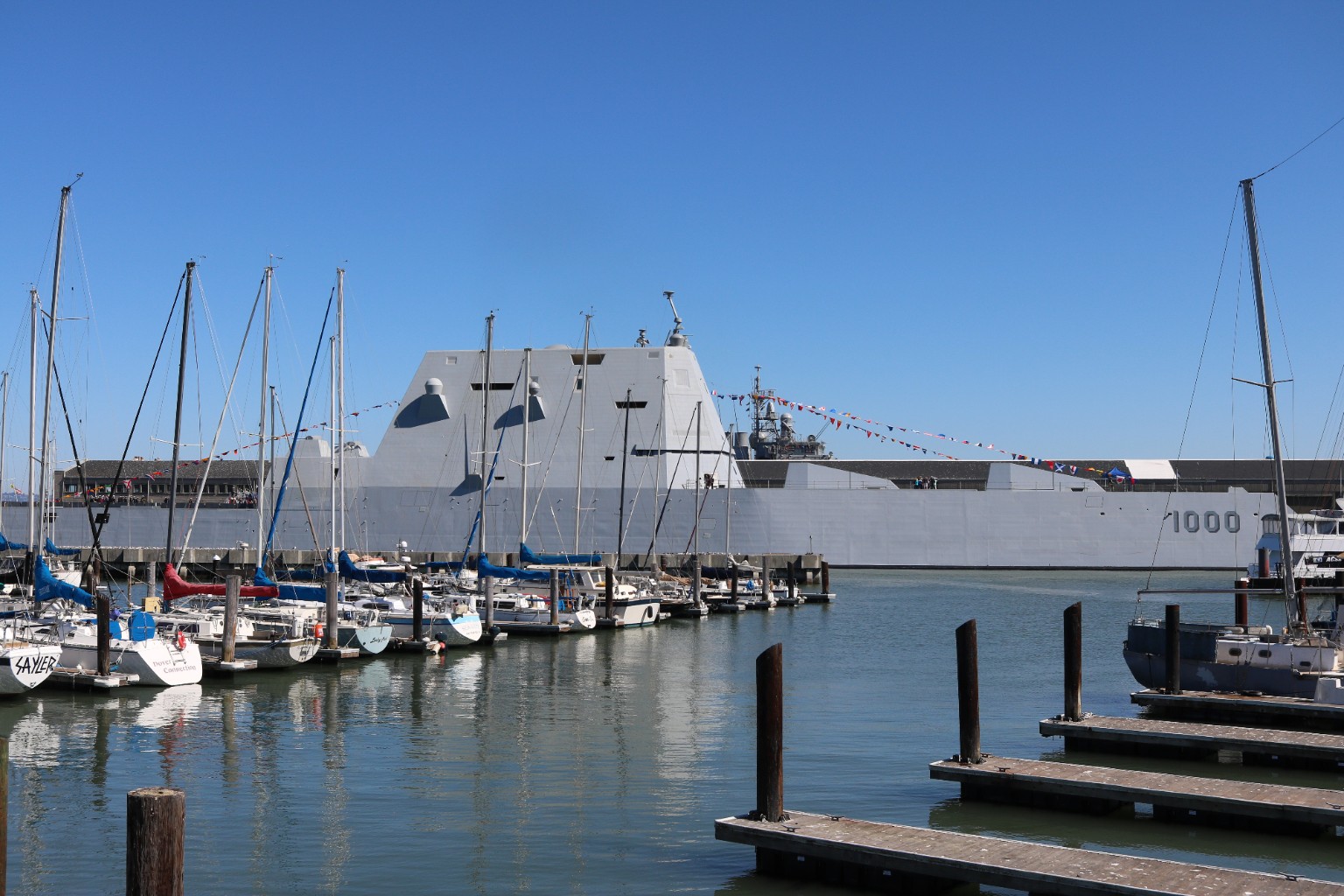
Ten years after commissioning, the most expensive destroyer the US Navy ever built has yet to fire a shot in combat. USS Zumwalt (DDG-1000) and her two sisters, Michael Monsoor and Lyndon B. Johnson, have spent their careers in trials, in shipyards, and in occasional Pacific exercises. They have not fought.
That is about to change on paper, if not yet at sea. The class is being rebuilt around the Conventional Prompt Strike hypersonic missile, and for defense investors the money trail now matters more than the ship’s strange silhouette. Huntington Ingalls, Lockheed Martin and the Navy’s budget office all have something riding on whether this second life works better than the first.
For a ship that looks like it sailed out of a film set, the record is thin. Zumwalt commissioned in 2016, sailed to San Diego, and didn’t finish combat system activation until April 2020. Her first real operational outing came in 2022, a three-month Western Pacific stint built around exercises, joint training and a first maintenance stop away from home port in Hawaii. In August 2023 she went into Ingalls Shipbuilding in Pascagoula, Mississippi, and stayed there for more than two years.
How a 32-ship plan became three orphans
The Zumwalt began as a fleet. The plan called for 32 ships, then 16, then eight, then three. Every cut spread the same research bill over fewer hulls. By 2016 the program total stood around 22.5 billion dollars, roughly 7.5 billion per ship once development is counted, and the per-ship growth tripped a Nunn-McCurdy breach. Even the flyaway cost of about 4 billion per hull was double what a modern Arleigh Burke runs.
The gun was the real wound. The ship was designed around two 155mm Advanced Gun Systems firing a guided shell, the LRLAP, meant to support troops ashore from long range. With only three ships to feed, the shell’s price climbed past 800,000 dollars a round and the Navy cancelled it. The ships kept their guns and lost their ammunition. For years the Zumwalt was a destroyer in search of a job.
The hypersonic refit gives the class a mission
The job arrived in the form of Conventional Prompt Strike, a boost-glide weapon shared with the Army’s Long Range Hypersonic Weapon. A two-stage rocket throws a glide body that carries a kinetic warhead, built to slip past air defenses and hit high-value targets fast. On Zumwalt, the forward gun mount came out and four large tubes went in, each holding three missiles. That’s up to 12 hypersonic rounds per ship.
The milestones are stacking up. Zumwalt finished builder’s sea trials in January 2026, her first time at sea since 2023. On March 31, 2026 the Navy awarded Lockheed Martin Space a contract modification worth about 1.356 billion dollars for CPS production and integration aboard the ship. Navy documents from July pointed to a return to active service in September, with the launchers fitted but no missiles aboard. The first at-sea CPS firing from Zumwalt is planned for 2027.
Lyndon B. Johnson is next in line. Ingalls picked up a 99 million dollar contract modification this month to run her sea trials while she receives the same weapon system, which will make her the second CPS ship. Michael Monsoor follows later.
What the market should watch
The weapon is not cheap either. Development and fielding of CPS have been estimated at around 21.5 billion dollars, with each missile at roughly 90 million. A fully loaded three-ship force would carry 36 rounds. That’s a magazine worth more than three billion dollars before anyone fires a test shot from a surface ship.
For Huntington Ingalls (HII), the class has become steady modernization and trials work at Pascagoula, a reliable stream of contract mods rather than a growth story. For Lockheed Martin (LMT), CPS is the bigger prize. The Navy also plans to put the weapon on Virginia Block V submarines, and a working destroyer installation helps prove the launcher and fire control before the submarine version scales up. General Dynamics (GD), whose Bath Iron Works built the hulls, and RTX, which supplied mission systems, are now mostly in the background.
The schedule risk sits with the missile, not the ship. Watchdogs have already flagged that CPS development issues could delay fielding on Zumwalt, and every slip leaves a refitted destroyer with empty tubes.
There’s also a lesson the Pentagon is being asked to apply right now. In December 2025 President Trump announced the Trump-class battleship under his Golden Fleet plan, a large surface combatant that Navy leaders have suggested could take the place of the DDG(X) next-generation destroyer. Congressional analysts have put early cost estimates as high as 22 billion dollars. The Zumwalt story is the obvious warning: a cutting-edge hull built in tiny numbers, around a weapon that is not ready, can end up costing carrier money and doing very little.
Zumwalt may finally get to prove it can fight. She’ll do it a decade late, with a weapon nobody planned for when she was designed.