Refueling aircraft are now the most reliable indicator of what Washington intends to do about Iran, and the most useful lever it holds over how the war gets fought. Carrier movements are slow, ambiguous and expensive. Bomber deployments are a commitment. Tankers are neither. They are cheap to move, legible to everyone watching flight tracking data, reversible within days, and they decide what every other aircraft in the theatre is physically capable of doing.
In the last week of February 2026, fourteen American refuelers landed at Ben Gurion Airport, nine of them overnight. At the same time tankers were clearing out of Al Udeid in Qatar. Those two movements, read together, told anyone paying attention what was about to happen, and they were public before any strike was.
The tanker is the throttle
A fighter’s combat radius is a fixed number. What is not fixed is how far past that number it can be pushed, how long it can hold over a target, and how many waves can be flown before crews and airframes run out. All three are set by available fuel in the air. During the February and March campaign, Israeli aircraft were operating at ranges around 2,000 kilometres from home, well beyond what F-15I, F-16I and F-35I packages can do unrefueled. The tanker fleet decides whether that is a single demonstrative strike or a sustained campaign.
That makes refueling a policy instrument rather than a logistics function. Washington can widen or narrow Israel’s reach without deploying a single strike aircraft, without a congressional argument, and without an announcement. It can grant depth for one target set and withhold it for another. There is no cleaner form of leverage over an ally’s war, and no quieter one.
The same applies in reverse as signalling toward Tehran. A tanker surge is a statement of capability that carries no casualties and no commitment. It can be walked back. It is also unhideable, which is the point. Refueling aircraft flying the Atlantic in numbers are a message written in a medium the recipient cannot fail to read.
Why the Gulf stopped working
For thirty years the answer to where American airpower sits in this region was the southern shore of the Persian Gulf: Al Udeid, Al Dhafra, Bahrain, Kuwait. That arrangement was designed against a defeated Iraq. It has not aged into a confrontation with a state that fields large numbers of ballistic missiles and drones.
Two things broke it. First, the hosts stopped consenting. In January, ahead of the escalation, Gulf governments made clear to Washington that their territory and airspace would not be used to launch attacks on Iran. That position had been forming since June 2025, when Iran struck Al Udeid in response to the American strikes on Iranian nuclear sites, and it hardened when the opening days of the 2026 war brought Iranian missiles and drones down on GCC states including the UAE, Saudi Arabia, Qatar and Oman, hitting civilian sites as well as bases. Hosting the American presence turned out to import the war rather than deter it.
Second, the physical case collapsed. Tankers are large, slow, unstealthy, packed with fuel and parked in the open. They are the most valuable and least survivable things on any ramp. Putting dozens of them a few hundred kilometres from Iranian launchers, at fixed and well-surveyed coordinates, on soil whose owner is trying to stay out of the fight, stopped being a plan. Hence the departure from Al Udeid before the campaign opened. The base that was built to project force became a place to move assets out of.
What Israel offers, and what it does not
Israel solved the political half of the problem completely. There is no permission question, no caveat on use, no host government trying to preserve neutrality while American aircraft take off from its runways. The government wants the tankers there and wants them used. That alone puts Israel in a category no Gulf state now occupies.
The practical half is close behind. Ben Gurion has the runway length, pavement strength and apron space for KC-46 and KC-135 operations in hot conditions, with Ramon and the military fields available for dispersal. Air defence is layered, tested, and already integrated with American systems and crews. Command relationships are established rather than negotiated.
Calling it the safest destination requires a qualification. Israel is not a sanctuary. It absorbs ballistic missiles, and a handful of airfields holding dozens of high-value aircraft is exactly the concentration problem that made the Gulf ramps untenable. What Israel offers is not immunity from fire. It is the combination of assured access, unrestricted use and defences that are actually engaged on the American side, which is a different and, for now, better trade.
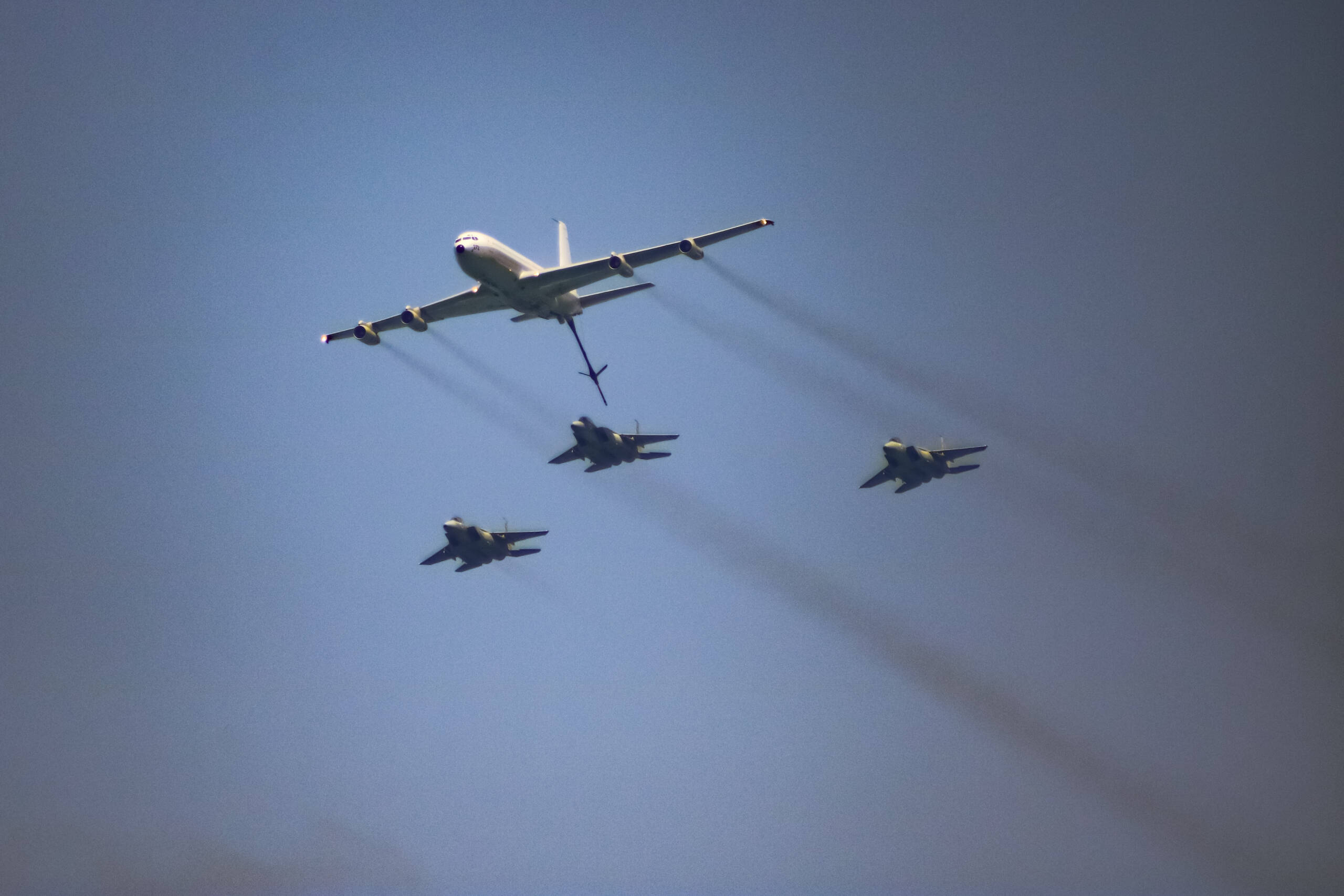
The seven old airframes in the picture
None of this would matter if Israel could fuel its own war. It cannot. The backbone of Israeli refueling has been roughly seven converted Boeing 707s, in service since the 1970s and averaging about half a century in age, flown alongside a similarly elderly handful of KC-130Hs. Structural fatigue, spare part scarcity and limited offload capacity made tanker availability the binding constraint on Israeli strike operations against Iran, and the reason American aircraft had to fly in to make the deeper missions possible at all.
The fix is arriving, slowly. The first KC-46, designated Gideon in Israeli service, was delivered to Nevatim on 27 May 2026, with the second arriving last week and six planned in total. That is a meaningful improvement in offload and endurance per aircraft. It is not a substitute for dozens of American tankers. Six aircraft change what Israel can do alone in a short campaign. They do not change who controls the ceiling on a long one.
A surge that turned into a posture
The most consequential detail is duration. Reports in May indicated that American tanker aircraft and their support personnel could remain in Israel into late 2027. A deployment measured in years is not a response to a crisis. It is a basing decision, and it amounts to a forward American air refueling hub in Israel without anyone having to call it a base or negotiate a status agreement for it.
That has costs that are not being priced. The American tanker fleet is finite, largely built in the 1950s and 1960s, and already the acknowledged bottleneck in any Pacific contingency. Every airframe parked at Ben Gurion until 2027 is an airframe not available to plan around elsewhere. The Middle East has a habit of consuming enablers that were supposed to be theatre-flexible.
What used to be measured in carrier strike groups is now measured in booms and offload tonnage. The instrument changed. Nobody announced it.
Leave a Reply